Trapezoid vs Parallelogram: Key Differences
Learn the key differences between trapezoids and parallelograms, including their properties, area formulas, and how to tell them apart.
Introduction
Trapezoids and parallelograms are both quadrilaterals, but they have distinct properties that set them apart. Understanding these differences is essential for geometry students and professionals alike.
What Makes a Trapezoid?
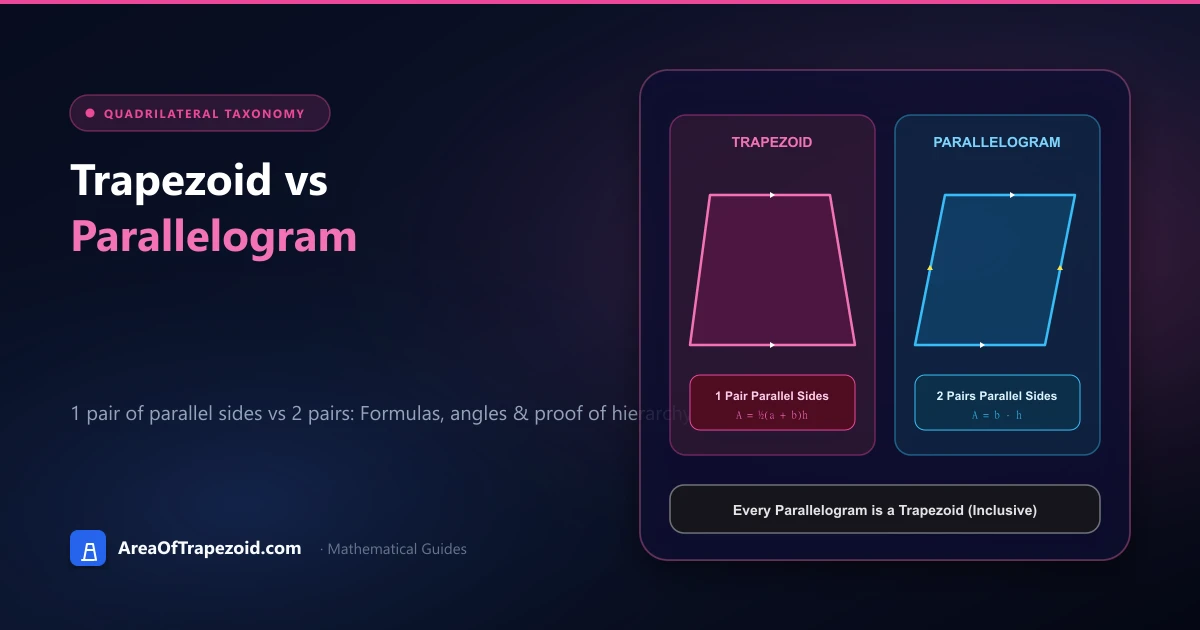
A trapezoid has exactly one pair of parallel sides. The parallel sides are called bases, and the non-parallel sides are called legs.
Properties of a Trapezoid:
- One pair of parallel sides
- The sum of interior angles equals 360°
- The midsegment (median) is parallel to both bases and equals their average
What Makes a Parallelogram?
A parallelogram has two pairs of parallel sides. Opposite sides are equal in length and opposite angles are equal.
Properties of a Parallelogram:
- Two pairs of parallel sides
- Opposite sides are equal
- Opposite angles are equal
- Diagonals bisect each other
Area Formulas Compared
| Shape | Formula | Variables |
|---|---|---|
| Trapezoid | A = ½ × (a + b) × h | a, b = bases; h = height |
| Parallelogram | A = b × h | b = base; h = height |
Notice that a parallelogram’s formula is simpler because both bases are equal, so the trapezoid formula simplifies to A = b × h when a = b.
Conclusion
While both shapes are quadrilaterals, the key difference is the number of parallel sides. A trapezoid has one pair, while a parallelogram has two. Understanding this distinction helps in correctly identifying shapes and applying the right area formula.