How to Calculate Trapezoidal Land Area: Acres, Sq Ft, and Irregular Lots Guide
Learn how land surveyors measure and calculate trapezoidal plots of land in square feet, square meters, acres, and hectares with practical property boundary examples.
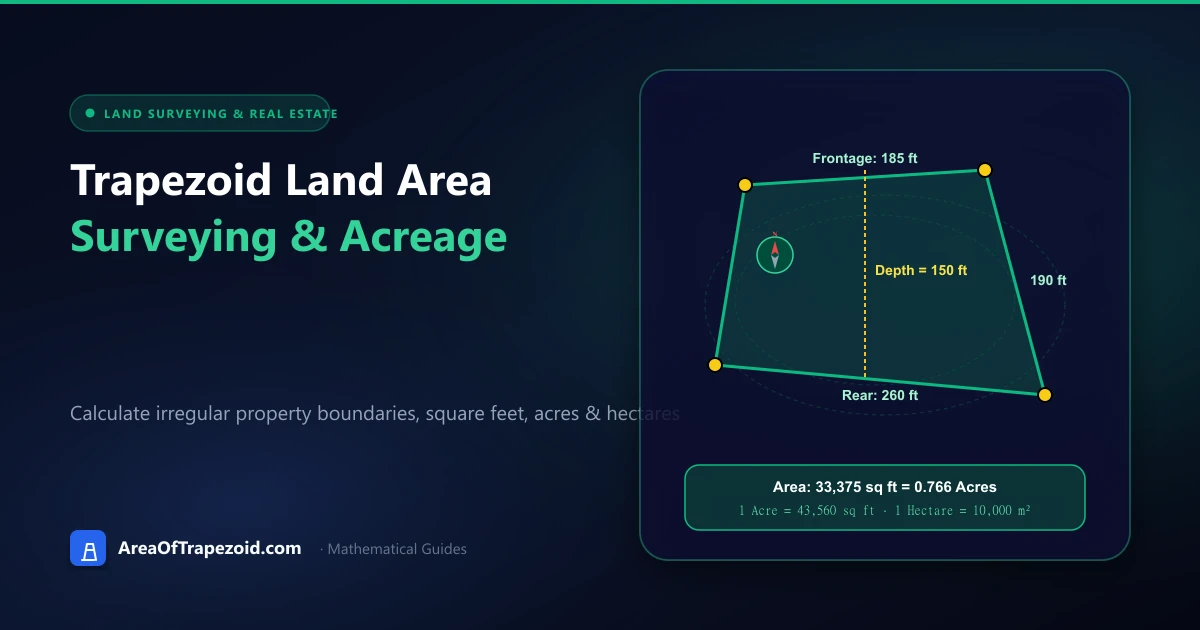
When buying, selling, or subdividing real estate, you will frequently encounter property parcels that are not perfect rectangles or squares. Road frontages, cul-de-sacs, rivers, and utility easements often carve lots into trapezoidal land plots.
Fortunately, calculating the acreage of a trapezoidal plot is one of the most reliable and straightforward calculations in surveying. In this guide, you will learn how to measure the boundaries accurately, convert units, and compute total acreage or square footage.
The Fundamental Land Area Formula
To calculate the area of any trapezoidal lot, you need three primary measurements:
- Frontage parallel boundary (a) — e.g., the street boundary
- Rear parallel boundary (b) — e.g., the back property line
- Perpendicular depth / setback distance (h) — the straight perpendicular distance between front and rear lines
The Mathematical Formula:
Area = ½ × (a + b) × h
In plain English: Average the two parallel boundaries and multiply by the perpendicular depth.
Step-by-Step Calculation: Real Estate Example
Suppose you are evaluating a suburban lot with the following survey measurements:
- Street Frontage (a): 120 ft
- Back Property Line (b): 180 ft
- Perpendicular Depth (h): 150 ft
Step 1: Calculate Area in Square Feet
Area = ((120 + 180) / 2) × 150 = 150 × 150 = 22,500 sq ft
Step 2: Convert Square Feet to Acres
In United States and international surveying:
1 Acre = 43,560 square feet
Divide your square footage by 43,560:
Acres = 22,500 / 43,560 ≈ 0.5165 Acres
(Your parcel is just over half an acre!)
Metric Land Measurements: Square Metres to Hectares
In metric surveying (used across Europe, Australia, India, and Canada), boundaries are measured in metres:
1 Hectare (ha) = 10,000 square metres (m²)
Example:
- Base a = 40 m
- Base b = 60 m
- Perpendicular Depth h = 50 m
Area = ((40 + 60) / 2) × 50 = 50 × 50 = 2,500 m²
Hectares = 2,500 / 10,000 = 0.25 Hectares
Regional Land Units: Gunthas and Cents
In Indian land records and South Asian surveying, local agricultural units are widely referenced:
- 1 Cent: Equals 435.6 sq ft (0.01 acre)
- 1 Guntha: Equals 1,089 sq ft (0.025 acre)
- 1 Bigha: Varies regionally (typically 14,400 to 27,225 sq ft)
For instance, our 22,500 sq ft plot equals:
22,500 / 435.6 ≈ 51.65 Cents or 22,500 / 1,089 ≈ 20.66 Gunthas
3 Critical Traps to Avoid When Measuring Land
-
Never use the side boundary fences as the height: Unless a side property fence is strictly perpendicular (90°) to both front and rear roads, the side fence is a sloping leg. Sloping legs are always longer than true perpendicular setback. Measuring along a slant will artificially inflate your calculated land area.
-
Verify that the two boundaries are truly parallel: If the front street and rear lot line are not parallel, the shape is a general irregular quadrilateral. To measure such land, either divide the plot into a trapezoid plus a triangle, or measure the diagonal and apply coordinate geometry.
-
Check for building setbacks and utility easements: Gross lot acreage determines property taxes, but net usable acreage may be constrained by local zoning setbacks.
Instant Online Calculation
Instead of doing manual conversions between linear feet, rods, chains, acres, and hectares, you can test all dimensions instantly on our dedicated:
👉 Trapezoid Land Area Calculator
The tool supports mixed units, live regional conversions, and instant printable step-by-step documentation for your records.