Calculating Trapezoid Area with 4 Sides: Heron's Formula & Impossible Geometry
How to calculate the area of a trapezoid when all 4 side lengths are known without height. Learn Euler's virtual triangle derivation and how to detect impossible trapezoids.
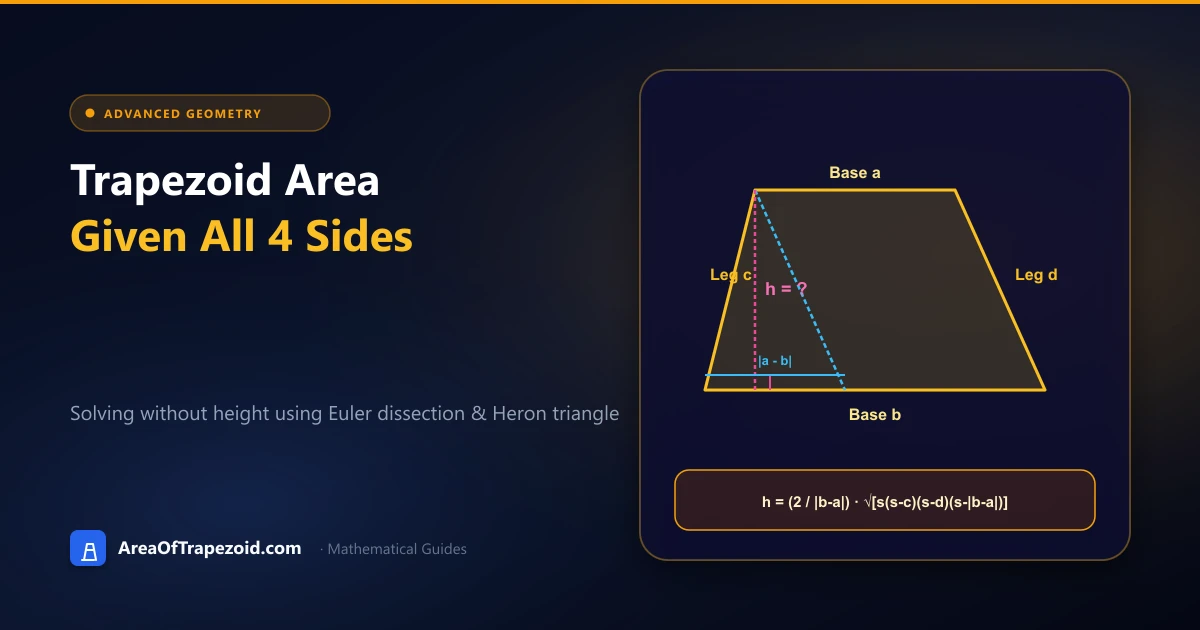
Can you calculate the area of a trapezoid if you only know the lengths of all four sides (a, b, c, d), but have no measurement for its height?
The answer is yes—provided the side lengths satisfy geometric existence conditions. While most textbooks only teach the basic formula A = ½ × (a + b) × h, advanced geometry enables us to determine the perpendicular height and total area from the four perimeter sides alone.
In this article, you will learn the elegant geometric derivation based on Heron’s formula, how to execute the algebra step-by-step, and how to spot “impossible trapezoids” before they produce erroneous calculations.
The Core Concept: Translating One Leg to Form a Triangle
Consider a trapezoid with parallel bases a and b (assume b > a), and non-parallel sides c and d.
If you shift side d leftwards until its top vertex coincides with the top vertex of side c, you construct a virtual triangle whose sides are:
- Side 1: |b - a| (the difference between the parallel bases)
- Side 2: c (the left non-parallel leg)
- Side 3: d (the right non-parallel leg)
Because both the trapezoid and this virtual triangle share the exact same parallel bases, the altitude of this triangle is identical to the height of the trapezoid (h)!
Step-by-Step Mathematical Formulation
Step 1: Compute Semi-Perimeter of the Virtual Triangle
s = (|b - a| + c + d) / 2
Step 2: Apply Heron’s Formula to Find Triangle Area (K)
K = √[s × (s - |b - a|) × (s - c) × (s - d)]
Step 3: Extract Perpendicular Height (h)
Since the area of any triangle is K = ½ × base × h = ½ × |b - a| × h:
h = 2K / |b - a|
Step 4: Compute Trapezoid Area (A)
A = ½ × (a + b) × h
Substituting the altitude into the equation yields the unified 4-side formula:
Area = ((a + b) / |b - a|) × √[s × (s - |b - a|) × (s - c) × (s - d)]
Fully Worked Numerical Example
Let’s calculate the area of a trapezoid with:
- Top base a = 6 cm
- Bottom base b = 14 cm
- Left leg c = 7 cm
- Right leg d = 9 cm
1. Find the base difference:
|b - a| = |14 - 6| = 8 cm
2. Compute the semi-perimeter s:
s = (8 + 7 + 9) / 2 = 24 / 2 = 12 cm
3. Compute the virtual triangle area K using Heron’s formula:
s - |b - a| = 12 - 8 = 4s - c = 12 - 7 = 5s - d = 12 - 9 = 3
K = √[12 × 4 × 5 × 3] = √720 ≈ 26.8328 cm²
4. Extract perpendicular height h:
h = (2 × 26.8328) / 8 = 53.6656 / 8 ≈ 6.7082 cm
5. Calculate final trapezoid area A:
A = ((6 + 14) / 2) × 6.7082 = 10 × 6.7082 = 67.082 cm²
How to Spot “Impossible Trapezoids”
Not every combination of four positive numbers forms a valid trapezoid. Because the virtual triangle has sides |b - a|, c, and d, these three lengths must satisfy the Triangle Inequality Theorem:
c + d > |b - a|(The two legs combined must span the horizontal gap)|b - a| + c > d|b - a| + d > c
Example of an Invalid Combination:
Suppose you enter:
- a = 5, b = 25 → |b - a| = 20
- c = 6, d = 8
Here, c + d = 6 + 8 = 14. But the base difference is 20! The two legs are too short to connect the bases, meaning the shape cannot close. A mathematically robust calculator will flag this geometry as impossible.
Test Your Measurements Instantly
Want to calculate 4-side trapezoid problems with automatic validation and step-by-step arithmetic? Try our: